• Skip to main content
  • Skip to primary sidebar
  • Skip to footer

Website of Steve Neff

  • BLOG
  • SHOP
  • MY ACCOUNT
  • RAVES
  • CONTACT

Search Neffmusic

You are here: Home / Reviews / Mouthpiece Reviews / Alto Mouthpiece Reviews / Alto Medium Baffle Reviews / New NY Meyer Alto Saxophone Mouthpiece Compared to a Vintage NY Meyer Alto Sax Mouthpiece Review

New NY Meyer Alto Saxophone Mouthpiece Compared to a Vintage NY Meyer Alto Sax Mouthpiece Review

June 22, 2019 by Steve 19 Comments

Since I recently wrote a review for a new NY Meyer (2019) alto saxophone mouthpiece as well as a vintage NY Meyer (1960’s) alto saxophone mouthpiece, I thought it would be interesting to do a side by side review of these two great alto saxophone mouthpieces side by side.

These are from the “mouthpiece fun box” that Jimmy Jensen at Tenor Madness sent me with interesting and great mouthpieces he thought I would like to check out.  Both of these alto mouthpieces have both been refaced by Jimmy.  The vintage NY Meyer alto sax mouthpiece is refaced to a .071 and the new NY Meyer alto saxophone mouthpiece is refaced to a .074.  Being that both alto mouthpieces have been refaced by the Jimmy Jensen and there is only a .003 difference in tip openings between each mouthpiece, I thought they would be good to compare to each other.

Side by Side-New NY Meyer on Left. Vintage NY Meyer on Right

I already anticipate some of you complaining that these are not original Meyer mouthpieces, and to do the comparison accurately, I would need original Meyer mouthpieces to compare.  The truth is that even with original mouthpieces there are differences between each mouthpiece of the same model.  I believe these two NY Meyer mouthpieces still retain the qualities that are consistent with each of the models as far as sound and tone and are worthy of  comparison.

I talked to Jimmy Jensen about these two mouthpieces and this is what he said about his work and refacing on them:

I’ve acquired facing measurements off of hundreds, possibly thousands of vintage pieces at this point. I save my favorite curves and put those on my pieces. So my vintage NY USA, I took the facing measurements from and I’ve kept those true, just opened the tip because it was .067 stock.  On the new one I put the same facing numbers and table style on it as the vintage ones.  Essentially it’s what I would expect to see on an untouched vintage NY USA Meyer.

As far as vintage pieces, there’s going to be variance no matter what. Rubber warps over time, you get dings, I rarely like a completely stock vintage piece. Usually they need just a tiny bit of freshening up. And I’m a minimalist in my facing. I try to keep them as close to stock as possible, but playing well-Jimmy Jensen

I have posted photos throughout this review of the new NY Meyer mouthpiece next to the vintage NY Meyer mouthpiece so that you can see how each mouthpiece looks and compares physically.

The mouthpieces look pretty similar on first glance.  Of course, the vintage NY Meyer mouthpiece is more faded and not as shiny as the new NY Meyer mouthpiece.  The new NY Meyer body looks slightly larger in diameter than the vintage Meyer body.  The beak also looks slightly thicker on the new mouthpiece from above but it is so close that I’m not 100% confident that I am correct.  From the side, the new NY Meyer mouthpiece beak also looks a tad bit thicker than the vintage NY Meyer mouthpiece.

New NY Meyer Alto Mouthpiece Refaced By Jimmy Jensen to a .074 Tip Opening
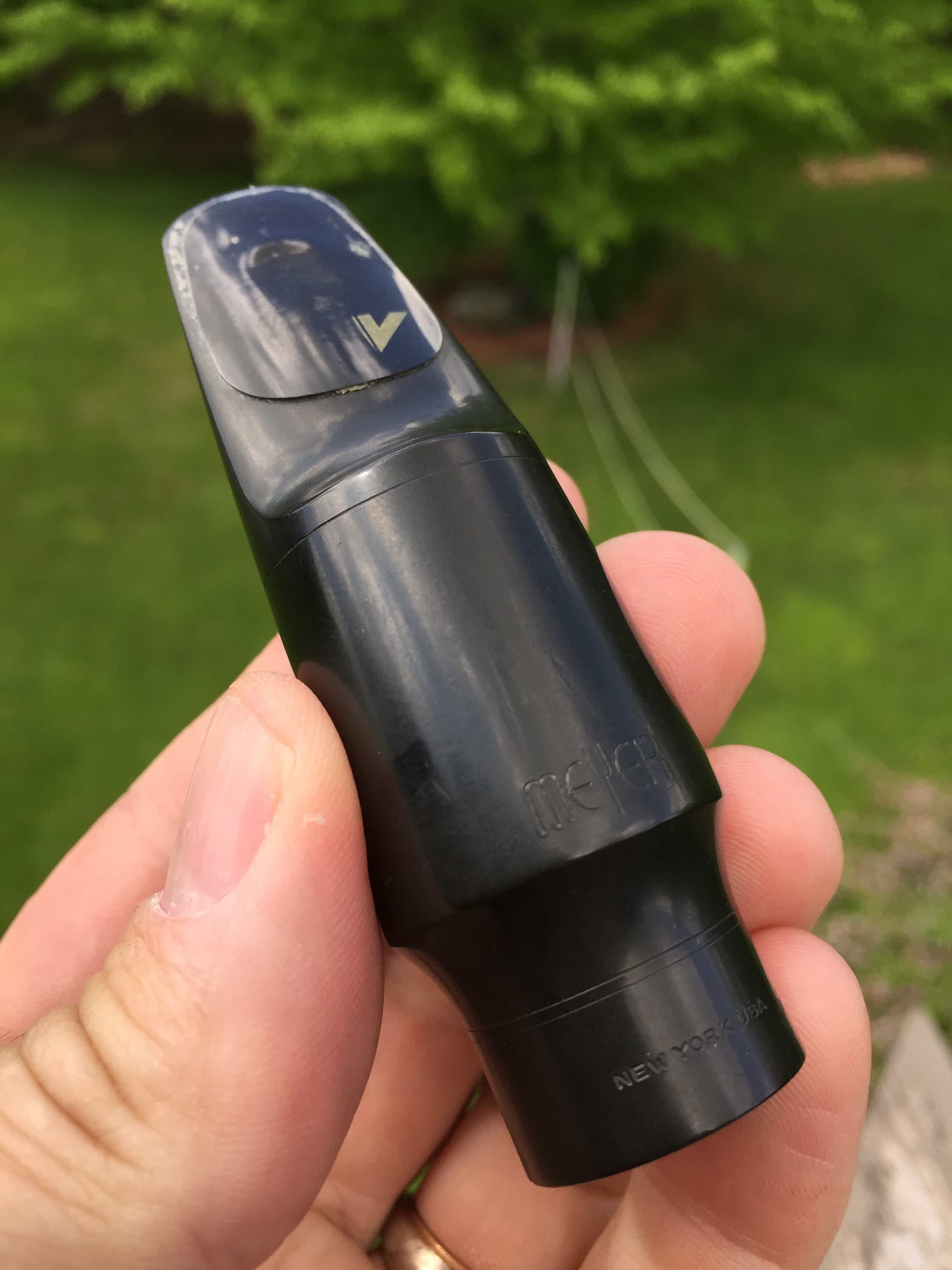
Vintage NY Meyer Alto Mouthpiece Refaced By Jimmy Jensen to a .071 Tip Opening

Next are the table comparisons.  Both alto sax mouthpieces have been refaced as I mentioned above.  The refacing process does affect the table but I will still write about what I see.  The vintage NY Meyer mouthpiece has a thinner table than the new NY Meyer mouthpiece.  It also looks like the window opening is slightly wider on the new NY Meyer alto sax mouthpiece than  on the vintage NY Meyer mouthpiece.  Both tables look to be the same length and both sax mouthpieces as a whole look to be the same length.

The engraving on the shank of the vintage NY Meyer mouthpiece has “New York USA” on the top of the shank and on the bottom is engraved “medium chamber”.  The new NY Meyer alto mouthpiece has “Made in USA” on the top of the shank and “NEW YORK” on the bottom.  The new NY Meyer also has a serial number engraved on the right side of the body as you look at it from the table side of the mouthpiece.

New NY Meyer Alto Mouthpiece Refaced By Jimmy Jensen to a .074 Tip Opening
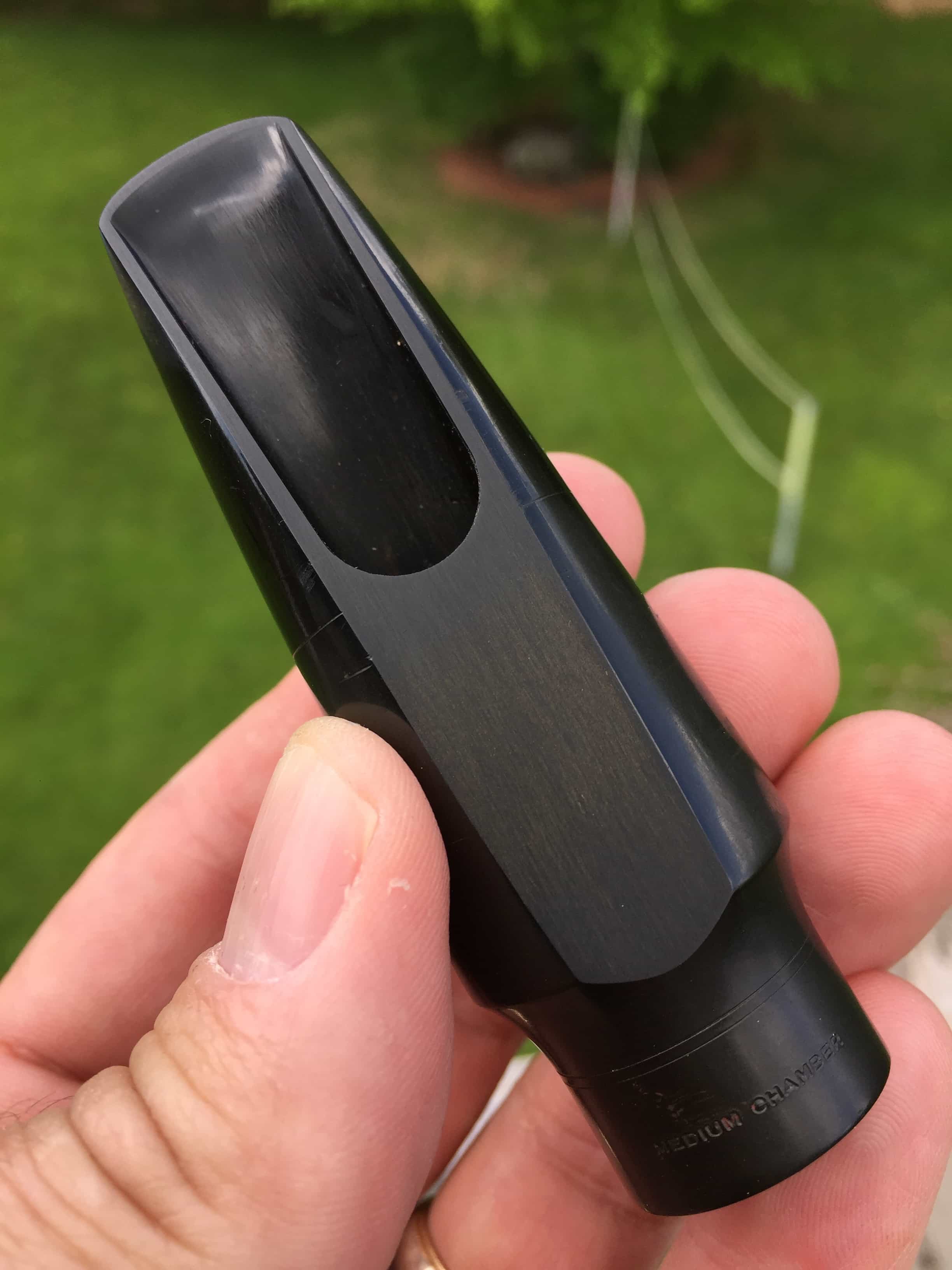
Vintage NY Meyer Alto Mouthpiece Refaced By Jimmy Jensen to a .071 Tip Opening

The baffle areas of both NY Meyer mouthpieces look very similar to my eye. I think the baffle on the new NY Meyer is slightly wider than the vintage model but the rollover and angle of descent down into the chamber looks almost identical.  The vintage NY Meyer mouthpiece might have a slightly more gradual curve of the baffle but it is hard to tell by eye.  They both look very similar.
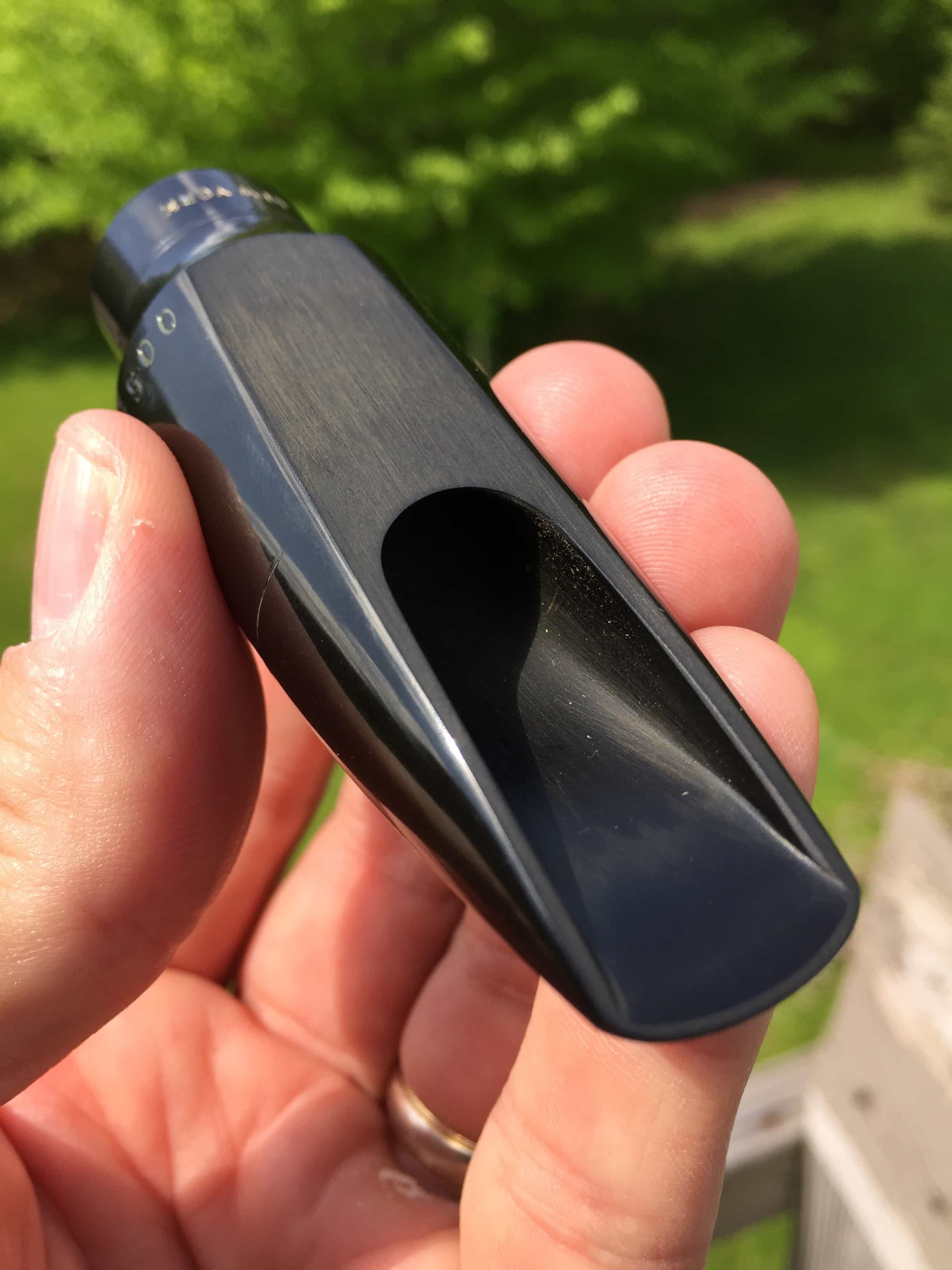
New NY Meyer Alto Mouthpiece Refaced By Jimmy Jensen to a .074 Tip Opening
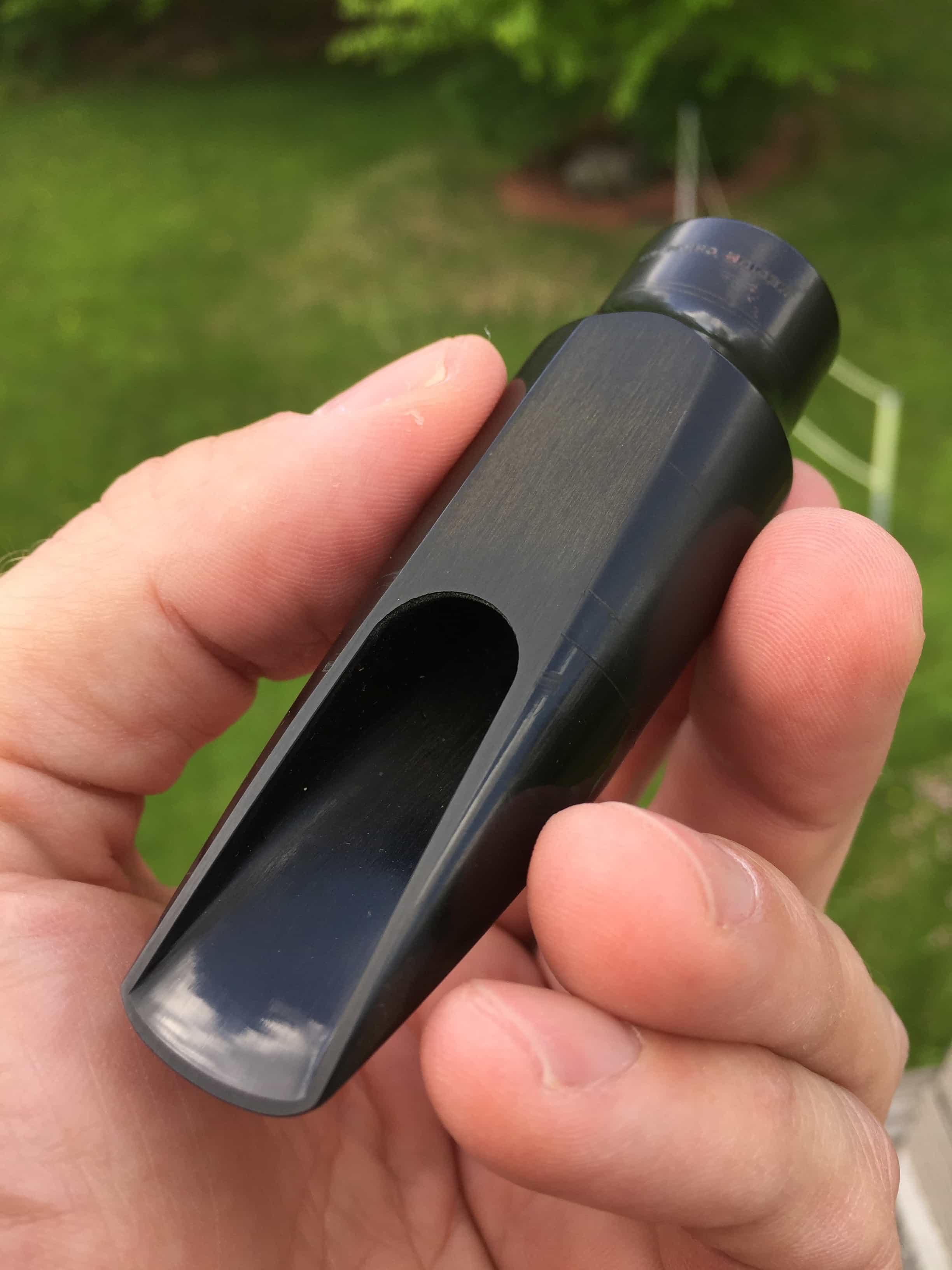
Vintage NY Meyer Alto Mouthpiece Refaced By Jimmy Jensen to a .071 Tip Opening

The tip rails and beginning of the baffle on each NY Meyer alto sax mouthpiece also look almost identical.  I can’t see any difference at all with my eye.  This exact similarity is probably due to Jimmy Jensen’s preferences in refacing tip rails and the baffle area.

The mouthpiece chambers are where I see the biggest difference between these two NY Meyer alto mouthpieces.  As you can clearly see in the pictures below, the new NY Meyer mouthpiece has a thinner roof to the chamber and a deeper cavity at the bottom of the chamber than the vintage NY Link alto mouthpiece.  This makes the chamber of the new NY Meyer mouthpiece larger than the vintage NY Meyer mouthpiece.

I’ll get into the differences in sound and playability below but I will say that, in general, I preferred the focus and core sound of the vintage NY Meyer mouthpiece over the fatter more spread tone of the new NY Meyer alto sax mouthpieces.  If I had to guess at the reason for this difference, I would guess that it is the difference in mouthpiece chamber size and shape.

Since these alto mouthpieces are only .003 difference in tip opening and the baffles look pretty identical next to each other, I would guess that this difference can be attributed to the chambers.  The smaller more round chamber of the vintage Meyer mouthpiece keeps the sound focused while the larger chamber of the new NY Meyer mouthpiece fattens and spreads the sound more.  This is my opinion anyways……..

New NY Meyer Alto Mouthpiece Refaced By Jimmy Jensen to a .074 Tip Opening

Vintage NY Meyer Alto Mouthpiece Refaced By Jimmy Jensen to a .071 Tip Opening

I have provided two sound clips of both NY Meyer alto sax mouthpieces below.  One is a new clip of the new NY Meyer alto saxophone mouthpiece refaced by Jimmy Jensen that I haven’t recorded or released until now.

The other clip is of the vintage NY Meyer alto sax mouthpiece that I used in the original review of that sax mouthpiece.  I actually recorded the two clips one after the other so there is a lot of similar material in each sound clip.   The same Woodstone 3 1/2 reed and Sumner Acousticut metal alto sax ligature was used on both mouthpieces to avoid any reed and ligature changes in sound.

Both clips were recorded in the exact same location with the exact same equipment and settings.

Here are some specific spots to listen for in the two recordings for comparison purposes:

  • In track 1 of the new NY Meyer mouthpiece, I play Phil Woods solo on “The Summer Knows” at :21-1:37 of the recording.  On track 2 of the vintage NY Meyer mouthpiece, I play the same exact solo at 2:10-3:30.
  • I also play the melody to “If I Should Lose You” on both tracks.  On track 1 of the new NY Meyer I play it at 2:20-2:36 and on track 2 of the vintage NY Meyer I play it at 3:57-4:24

The difference in sound and tone I heard while playing and the listening to the tracks are these:

  • I felt like the new NY Meyer mouthpiece had a more spread and fat alto sax sound than the more focused sound of the vintage NY Meyer alto mouthpiece.
  • The new NY Meyer mouthpiece sounded more brash and in your face.   The vintage NY Meyer mouthpiece sounded sweeter and more delicate. The new NY Meyer mouthpiece sounded more aggressive and the vintage NY Meyer mouthpiece sounded more polite to me.
  • The new NY Meyer mouthpiece was definitely more free blowing and the vintage NY Meyer had a little bit more resistance to work with.  Using the same reed really helped me  feel this as it felt slightly softer on the new NY Meyer than it did on the vintage NY Meyer.
  • The high register on the new NY Meyer mouthpiece sounded brighter and had a bit of edge to it while the vintage NY Meyer mouthpiece sounded darker and prettier to me.
  • Lastly, I think the more fat and spread tone of the new NY Meyer mouthpiece made the fast runs sound as if the individual notes were kind of bleeding together in sound making it sound less distinct and clear to my ear.  The focus of the vintage NY Meyer mouthpiece made the fast runs sound more clean and precise to my ear.   It’s almost like I could hear each separate note as it’s own voice even though I was playing fast runs and licks.

In the end, I think the new NY Meyer is a great alto mouthpiece.  I have played five up to this point and all five played great for me.  I also loved the vintage Meyer NY mouthpiece as was evident from my review I posted earlier.  Both mouthpieces had qualities that I enjoyed and liked while playing them and listening back to the recordings.

Although I totally loved the vintage NY Meyer alto mouthpiece, I wonder if the extra fatness, brightness and edge of the new NY Meyer might make it an alto sax mouthpiece the would cut through in the mix of a big band or modern band with amps and electronic instruments easier than the vintage NY Meyer alto mouthpiece.  I can’t answer that without playing in a live situation with both mouthpieces though.  Jimmy Jensen has played both of these alto sax mouthpieces so maybe he can answer that question in more detail…….

I will say, that I would be the first in line if JJ Babbitt made another version of this new NY Meyer mouthpiece with a slightly smaller chamber like the medium chamber of the vintage NY Meyer mouthpiece in this review.  I think the added focus and sweetness to the tone that is in the vintage NY Meyer is a really attractive quality to have in an alto sax mouthpiece.

These are some of my own observations from playing these two mouthpieces and listening to the clips afterwards.   Feel free to listen to the clips below and let me know what you think in the comments below.   Thanks,   Steve

https://cdn.neffmusic.com/2019/NewNYMeyerJJ.mp3

New NY Meyer Alto Mouthpiece Refaced By Jimmy Jensen to a .074 Tip Opening-Ishimori Woodstone 3 1/2 Reed

https://cdn.neffmusic.com/2019/VintNYMeyer.mp3

Vintage NY Meyer Alto Mouthpiece Refaced By Jimmy Jensen to a .071 Tip Opening-Ishimori Woodstone 3 1/2 Reed
Disclosure: I borrowed the two mouthpieces reviewed above from a fan of my site and will be returning the mouthpieces after the review. Regardless, I only review mouthpieces that I enjoy playing and believe will be good for other saxophone players to try also. Steve

Filed Under: Alto Medium Baffle Reviews, Alto Mouthpiece Reviews, Mouthpiece Reviews Tagged With: alto mouthpiece, comparison, JJ Babbitt, NY Meyer, review, saxophone, Vintage

Steve

About Steve

Steve Neff has been playing and teaching saxophone and jazz improvisation around the New England area for over 30 years. He is the author of many best selling jazz improvisation methods as well as founding the popular jazz video lesson site Neffmusic.com.

Reader Interactions

Comments

  1. AvatarJeff Schachinger says

    June 22, 2019 at 11:38 am

    Sounds great. I hear a little more buzz in the vintage piece. I like them both!

    Reply
  2. AvatarDoug Henry says

    June 22, 2019 at 12:05 pm

    I like the sound of the original NY Meyer. The new one sounds good, but just a little more modern to me. I like the core sound of the old one better. I think that both would be useful depending on the circumstances you are using them for. Another thing I think is that the old mouthpieces were made of a different composition of hard rubber than the new and that has something to do with the sound. Doug Henry

    Reply
  3. AvatarErik says

    June 22, 2019 at 4:40 pm

    They’re completely different, both great. I like the vintage NY USA quite a bit more. More depth and richness to the sound.

    Reply
  4. AvatarDavid Thomasson says

    June 22, 2019 at 4:45 pm

    I listened to the first track of the New NY Meyer and enjoyed it. I listened to the first 3 notes of the Vintage and melted in pure joy.

    Reply
  5. AvatarPAT ZICARI says

    June 23, 2019 at 11:09 am

    What would the difference have been if neither of the mouthpieces had been refaced…
    THAT is a comparison I’d like to hear…
    In other words, HOW does the new NY sound “out of the box”??? Compared to a Vintage NY that’s NOT refaced…

    Reply
    • SteveSteve says

      June 23, 2019 at 11:56 am

      I have already reviewed two new “out of the box” untouched NY Meyers. http://www.neffmusic.com/blog/2019/05/ny-meyer-100th-anniversary-model-alto-saxophone-mouthpiece-review/

      Reply
  6. AvatarPAT ZICARI says

    June 23, 2019 at 1:25 pm

    Steve…
    Thanks… that, at least, shows me that “out of the box” Meyers “work”…
    You know what I mean… there are some manufacturers out there that you NEED to reface to get to work properly…
    Alto, however, isn’t my “problem horn”…
    Am in the process, waiting for Vandoren, to get their complete line of V16’s into their Musician’s Studio… looking to get smaller than my .155 or 9*’s…
    Gettin’ old… and did a 2-hour show, with at least 3 chorus’s each song… my chops BEGGED me to make it smaller… lol
    Thanks, for showing me your Review of 100th Anniversary Myers..
    Pat

    Reply
    • SteveSteve says

      June 23, 2019 at 2:27 pm

      Pat, Someone on Facebook also said that this review was useless because the mouthpieces had been refaced. Here is my response:

      I disagree. Like I said in the review, even if I did have two original mouthpieces to review, there are such variances between mouthpieces from the factory that some would say the mouthpiece is a great example or some would say it is a poor example. At least with the reface we know there is a good curve on both. I have a review of two off the shelf new NY Meyers also if anyone is interested in the sound of the original mouthpieces. http://www.neffmusic.com/blog/2019/05/ny-meyer-100th-anniversary-model-alto-saxophone-mouthpiece-review/

      Also, I have probably had more mouthpieces refaced than anyone and although a reface can do great things to a mouthpiece that has issues or a poor facing curve. Every Meyer or Link I send out still comes back sounding like a Meyer or Link. I might dare say that the difference might be equal to the difference between who ends up working in the factory the day an original Meyer or Link is made. I have played plenty of the same original models that were totally different. So in my mind, we know that Jimmy put a great curve on both and from there we can judge the mouthpieces fairly between them based on how they play and their sound. If I took 10 vintage NY Meyers and 10 Modern NY Meyers I wouldn’t be surprised if I got a variety of facing curve numbers back from those 20 mouthpieces. Not to mention different table concavities. These pieces have been refaced so we know or can assume the tables are flat and the facing curves are good. Now we can compare them by how they play and sound………

      Reply
  7. AvatarPAT ZICARI says

    June 23, 2019 at 5:01 pm

    I guess I’m just a lucky man…
    At the making of almost all of my mouthpiece, I was present with the maker (or were made to my spec’s)…
    Exceptions Berg 130/0 offset M, 10mFan 9* Merlot, Vandoren V16A8s… my “store bought” mouthpieces… although wouldn’t consider the Merlot “store bought”…

    My question about the New NY was could I get one off the shelf, and play it… (knowing that I’d want/have to play more than one)… as I did my Vandoren… at their Musician’s Studio…

    And, yes, I have heard that there are some manufacturers out there putting out Crap Mouthpieces… that HAVE to be worked on to play…
    What happened to going out… telling the salesman what you wanted… opening up a couple of boxes to find the “one” you liked.. and buying it…

    P.S. I don’t agree with the guy on Facebook that your review “useless”… I found it VERY informative… especially the difference between the two different styles…
    If he didn’t hear that… oh, well… 🙂

    Reply
    • SteveSteve says

      June 25, 2019 at 9:35 am

      To all who feel the comparison isn’t valid because these pieces have been refaced, I messaged Jimmy Jensen this morning to get more info on his outlook on refacing. This is what he said:

      I’ve acquired facing measurements off of hundreds, possibly thousands of vintage pieces at this point. I save my favorite curves and put those on my pieces. So my vintage NY USA, I took the facing measurements from and I’ve kept those true, just opened the tip because it was .067 stock.

      On the new one I put the same facing numbers and table style on it as the vintage ones.

      Essentially it’s what I would expect to see on an untouched NY USA

      As far as vintage pieces, there’s going to be variance no matter what. Rubber warps over time, you get dings, I rarely like a completely stock vintage piece. Usually they need just a tiny bit of freshening up. And I’m a minimalist in my facing. I try to keep them as close to stock as possible, but playing well-Jimmy Jensen

      Reply
  8. AvatarTC Wilson says

    June 26, 2019 at 1:23 am

    I enjoy the Vintage Meyers piece , the tone of thr mouthpiece was great

    Reply
  9. AvatarPaul Dion says

    July 8, 2019 at 7:46 pm

    The NY gets my vote. Fatter sound. I’m not fond of the sweet, dare a I say old fashioned, alto sound.
    Both played beautifully Steve.

    Reply
  10. AvatarAndrew says

    July 20, 2019 at 2:46 pm

    Steve, try out Ed Pillinger’s mouthpieces. His Meyer style alto is based in a 1950 Meyer, is very good and at £200, much the same retail price as the new NY Meyer. He also makes an LA with a bigger chamber and a mouthpiece of the same design as Parker’s.

    Reply
  11. AvatarGrant Koeller says

    August 29, 2019 at 11:51 am

    I prefered the newer NY meyer. It had “that” sound. maybe the larger 074″ tip (meyer 6) .076″ was why,
    instead of the 071″ tip (Meyer 5 ). This comparison was like comparing apples to oranges. because of the difference in tip openings. I noticed that both mouthpieces sounded great and you could totally use any of these for big band lead alto. I own 4 meyers, three 7MM’s and one 6MM, and these sounded so great I’m dying to try out a New NY 7MM.
    Once again Thanks Steve for your fantastic mouthpiece reviews!!!
    King Koeller

    Reply
  12. Avatarfrank says

    July 8, 2020 at 12:58 pm

    Both great sounding pieces and I can easily be happy with either!!! To me there’s only 1 real question…Is the approximate 10 times price difference for the vintage piece be worth the difference in sound, performance, feel, etc.? From what I heard between the 2 recordings, I couldn’t justify the cost difference for myself – again, just speaking for myself!

    Also, replacing a vintage piece with yet another vintage piece doesn’t seem to be cost effective – replacing the newer piece would be.

    Again, their both great sounding pieces. If the cost difference is worth it, then it’s worth it – if it’s not, then it’s not. In either scenario, the sound is there…Thank you Steve for the demo. I’m glad I came across this.

    Reply
  13. AvatarGiuseppe C. says

    July 10, 2020 at 6:24 am

    I like best the new Meyer.
    Giuseppe.

    Reply
  14. AvatarGiuseppe C. says

    July 11, 2020 at 12:42 pm

    One of my favorite alto saxophonists is Jackie McLean; the fat and edgy sound of the new Meyer reminds me of the beautiful sound, which I like so much, that McLean has on the Prestige “Contour” album: A foggy day, Kerplunk, Inding, Lights out, Up, Lorraine, Sentimental journey, Why was I born ?, Contour, Confirmation, When I fall in love, Abstraction … Recordings from 1956.

    Reply
  15. AvatarJeffrey Newton says

    January 31, 2022 at 2:49 am

    Steve, do you have any observations as to how the 2019 JJ. Babbitt NY Meyer compares to the Drake Phil Woods? As in, does the Drake Phil Woods more closely align with the original NY Meyer, with the 2019 version, or neither? Any other observations would be appreciated as well. I currently have a 1993 Meyer 7 on my 66xxx Mark VI alto (I also have a Vandoren A7, but the 1993 Meyer is a better fit for it). Note: I played the Drake Pete Christlieb on my Mark VI tenor. Thanks.

    Reply
    • SteveSteve says

      January 31, 2022 at 9:59 am

      I have only played two or three old Meyers and they all played different from each other so it is hard to answer that question. In this review you are commenting on I go into detail on the differences between these two mouthpieces. I say the new NY Meyer is fatter and not as focused as the old NY Meyer and the Phil Woods is more focused. I think I remember the Phil Woods piece as being brighter but I didn’t play them next to each other so I don’t know for sure. The difference in brightness might be because of the material the pieces are made of but that is just a subjective opinion and many people believe material does not matter.

      Reply

Leave a Reply to Andrew Cancel reply

Your email address will not be published. Required fields are marked *

Primary Sidebar

Steve Neff

Cart

Subscribe to the Neffmusic Newsletter for the latest reviews and best deals delivered straight to your inbox every month. Join now and you will also receive my 40 Ultimate Michael Brecker Licks free!

Select list(s) to subscribe to


Thanks for joining!


NEFFMUSIC PRINTED BOOKS

Testimonials

Hello Steve,

I just want to say thank you so much for your unbelievable work, it is just mind opening, thanks for sharing it.

Wolfgang from Berlin

Wolfgang from Berlin
Steve- I joined your site this month and have downloaded 4 lessons and also purchased your new book and video on diatonic patterns. I just want to say I am very pleased with your approach and teaching techniques. I am getting back into playing after laying off for some time. The information you offer on your site is of great value and I am enjoying being a member. Thank you for what you are doing for the saxophone community.
Tony

I want to thank you again, because, not only are you an inspiration to listen to, you are a fine teacher!

I have been teaching sax and other winds for over 20 years, and you give me that “push” to give my students more!

Mark Peotter

Mark Peotter
First, I’m really excited about your materials! This site is a vast resource for any aspiring (and maybe already inspired) jazz musicians. I’m not a sax player, I play mandolin and fiddle, but have been learning jazz and playing weekly with a quintet for the past 6 months and have been struggling with all of the issues you get into in your lessons. I bought several books and lessons and plan to continue with some others as soon as I organize my practice routine. Thanks again for a great site … Read more
Tony Galfano
I bought Steve’s dominant bebop book and took a couple of online lesson from him. I really appreciated Steve’s careful listening of what I wanted to get done in a lesson and his clear, concise ideas on next steps to improve my playing and musical interpretation.  His mastering  the Dominant Bebop Scale has lots of exercises to use a scale that addresses the largest percentage of chords I come across in pop/blues music. The dominant V7.  Needless say it has improved my playing.  I teach and a… Read more
Keith
I would like to say that in the last year my sax playing has progressed loads from your lessons. I have had a sax for about 20 years and dabbled with lessons from a few teachers and have learnt very little from them. As you have said in your lessons many teachers tell you to use the blues scale and leave it there, not even showing you the resolution points!!. I am now believing I can in time become a good improviser.
Thanks again,
Shane
Shane
Hey Steve, I’m a 22-year-old from Australia. I thought it would be worth saying. You’re an absolute legend. I can’t thank you enough. You have helped me rekindle my love for the saxophone and music as a whole. All the best for the future, your work doesn’t go unnoticed. PS. I am loving your devastating minor lines pdf.
Sapph
I can’t say enough about my membership at Neff Music. Steve has taken the mystery out of playing the saxophone well and improvising both jazz and rock music. Like most struggling players I have a load of all sorts of books on my shelf just gathering dust. Books that I didn’t understand or know how to put to use…or just have the time to go threw them. Steve’s lessons really simplify things and he puts it in a way that I can understand. They inspire me to keep pushing and having him as my guide or… Read more
Ken

Steve, just a note to say thanks.

I’ve been playing a long time, but your material, laid out in such a thoughtful way, helps me to understand concepts in a new and deeper way.

You are a true gift to the jazz community.

60 lessons and going strong,

Kevin Ledbetter

Kevin Ledbetter
Hey Steve! I hope you and your family are well.  I’m just writing to say thank you so much for all the resources you have made available to the saxophone community. I have been using your material for many years and I always come back to it… in fact I just took a break from practicing to write this…( reviewing “CreatingModern II-V-I Lines with simple pentatonics”.) I am, and continue to be, one of your raving fans! Blessings to you and your family this holiday season! Wishing… Read more
Gerry Aylward
Hey Steve, My name is Jason Freese and I play keyboards and sax in the band Green Day.  I grew up taking sax lessons from Eric Marienthal when I was a kid and got out of it for a long time. I ran into you on youtube while searching for sax stuff. I bought a whole bunch of your lessons and have been loving it! Thanks! Here is my wikipedia so you can see the albums I’ve played on….Thanks again. It’s sparked my interest in practicing again.   Jason
Jason Freese (sax player for Green Day)
Just wanted to send you a quick note to say thank you for being you, your playing, your website and your desire to help others. I’m a professional musician in the US Army and I’ve visited your website almost every day since discovering it a couple of months ago. Your lessons are profound and easy to use. I’ve purchased most of your PDF books and now am starting to delve more into the video and audio lessons.  Thank you for being a great resource!
James

Thank You Steve. I think that I will be busy for years. Thank You for your great contribution to jazz music. Your books, more than teaching “how to play jazz”, actually teach “how to speak jazz”. I wish I found your methods years ago.  

Jean-Eric
Two years later I began a search for a sax teacher and happened to come across Steve Neff when I was searching YouTube for sax teachers.  I went to neffmusic.com and was very impressed with the lessons Steve Neff was offering.  The concept of selecting lessons was an approach that I thought was unique and purchased a few lessons.  I liked the lessons so much that I signed-up for a 6 month package. I was very happy with all the lessons I selected.  I also purchased Steve’s book Mastering the B… Read more
Michael
I can see from your instructional videos that you are a fantastic teacher – one that can truly relate to all ages – humble yet very positive in approach – never coming across as superior and yet so totally capable of demonstrating the principles and techniques that you seek to impart to the students. I have gained so much confidence in my playing from “pouring over” time and again these invaluable lessons. Invaluable not only in musical content, but also in human interaction content. I am absolu… Read more
Ron
Thank you so much for the great job you are doing to help further our jazz studies. Though I make my living as a repairer of musical instruments I am a student of jazz and have been fortunate enough to be involved with a big band and a combo for the last several years. As my children began to leave “the nest” I had decided to dedicate the next half of my life to a more serious study of the sax but I didn’t know exactly how I would go about doing this until a friend of mine turned me onto your si… Read more
Jon
I am enjoying your style of teaching, and you’ve done a great job with the videos….good sound quality and well constructed lessons.  Balances the more guitaristic material found on the majority of guitar based programs.  Jazz vocab is what I’m all about at this point in the journey.   I especially dig the fact that you’ve studied with Bergonzi…helps me see his voluminous output in a more  bite sized way.
Milton
I just wanted to write a thank you note to you for this website. I play and teach saxophone, but I have always been intimidated by the gear aspect. Your website has helped me become a lot more knowledgable. Your knowledge is staggering! I’m telling all my students about your website. Pierre
Pierre
I want to say something about Steve Neff’s series of lessons, Beginner Jazz Improvisation. For a couple of years I tried many beginner lessons and my problem was that there was a gap between lessons that were fairly simple and ones that I was not quite ready for and my progress stalled out. That problem was solved with the series Beginner Jazz Improvisation. He guides you step by step along the way and builds a foundation for learning jazz and blues. He leaves no question about what to practice … Read more
Pete
For anyone living in remote areas away from live jazz sax teachers, Neff is the way to go. In fact this is a great resource for anyone seriously interested in mastering the sax. I’ve never been disappointed in a lesson.
Oliver
I like so many other subscribers feel so encouraged by Steve’s learning techniques; you will enjoy reading the comments of praise others have left as you too will feel that you share a common view and path. I feel very lucky to have come across Neffmusic and that feeling will remain with you as you search through a treasure trove of learning materials on offer, you will quickly find the lessons that you are suited to. You will instantly recognize the unparalleled quality of Steve’s teaching … Read more
Stephen
I just joined Neff Music last month. I can’t tell you how excited I’ve been to be able to pick back up on lessons. I’ve been in a rut and you got me out! I’ve especially appreciated the Lesson Path section. It was so clear I knew exactly where to jump in and start. Many many thanks!
Karin
I just started looking at my lessons and I have to say, dude you are awesome.  I ABSOLUTELY will learn from you!  I started the tenor about 1 ½ yrs ago and have since picked up an alto, and more recently a soprano.  I spend most of the time on the tenor, followed by soprano, and have only gotten to the alto a few times.  I think I’ll be sticking with tenor.  I’m having a great time and hope one day to play well enough to get regular gigs.  I’ve been playing keys for about 35 years (… Read more
Wil
I’ve been downloading your lessons for 4 months now (20 lesson) and I have noticed tremendous growth in my playing thus far! I’m so happy that I stumbled upon your site!
Bob

Featured Video Lessons

  • Mastering the Dominant Pentatonic Sound over a Blues (Digital PDF Book) Mastering the Dominant Pentatonic Sound over a Blues (Digital PDF Book)
    Rated 5.00 out of 5
    $19.99 Original price was: $19.99.$14.99Current price is: $14.99.
  • The Secret to Modern Outside Jazz Lines Lesson-Minor The Secret to Modern Outside Jazz Lines Lesson-Minor $9.99
  • Creating Modern II-V-I Lines with Simple Pentatonics Lesson Creating Modern II-V-I Lines with Simple Pentatonics Lesson
    Rated 5.00 out of 5
    $9.99
  • The Best Embouchure for Tone, Intonation and Endurance Lesson The Best Embouchure for Tone, Intonation and Endurance Lesson
    Rated 4.91 out of 5
    $9.99
  • Devastating Dominant Lines for Jazz and Funk Soloing (Digital PDF Book) Devastating Dominant Lines for Jazz and Funk Soloing (Digital PDF Book)
    Rated 5.00 out of 5
    $14.99
  • Mastering the Minor ii-7b5 V7b9 Bebop Scale (Digital PDF Book) Mastering the Minor ii-7b5 V7b9 Bebop Scale (Digital PDF Book)
    Rated 5.00 out of 5
    $14.99

Now over 600 video and audio lessons to choose from!

Free Lessons

  • Free Lesson on The New Ultimate II-V-I Primer-Major Keys
  • Free Video Lesson on Mastering Altered Pentatonics
  • Free Video Lesson on Mastering the Blues Scale Volume 1 & 2
  • Free Video Lesson on Mastering the Dominant Bebop Scale and Language Book 1 & 2
  • Free Video Lesson on Approach Note Velocity Book

Recent reviews

  • Mastering Altered Pentatonics (Digital PDF Book) Mastering Altered Pentatonics (Digital PDF Book)
    Rated 5 out of 5
    by Jim Ramsey
  • Practicing Double-Time Licks Lesson Practicing Double-Time Licks Lesson
    Rated 5 out of 5
    by Az Samad
  • Bebop Scale-Altered Scale II-V-I Practice Lesson Bebop Scale-Altered Scale II-V-I Practice Lesson by Noah
  • Mastering the Dominant Pentatonic Sound over a Blues (Digital PDF Book) Mastering the Dominant Pentatonic Sound over a Blues (Digital PDF Book) by Andy
  • Mastering the Dominant Pentatonic Sound over a Blues (Digital PDF Book) Mastering the Dominant Pentatonic Sound over a Blues (Digital PDF Book)
    Rated 5 out of 5
    by Russ
  • Sale! Mastering the Dominant Pentatonic Sound over a Blues (Digital PDF Book)

    Mastering the Dominant Pentatonic Sound over a Blues (Digital PDF Book)

    Rated 5.00 out of 5
    $19.99 Original price was: $19.99.$14.99Current price is: $14.99.
    Add to cart
  • Sale! Mastering Altered Pentatonics (Digital PDF Book)

    Mastering Altered Pentatonics (Digital PDF Book)

    Rated 4.75 out of 5
    $26.98 Original price was: $26.98.$14.99Current price is: $14.99.
    Add to cart
  • Mastering Major Diatonic Patterns (Digital PDF Book)

    Mastering Major Diatonic Patterns (Digital PDF Book)

    Rated 5.00 out of 5
    $14.99
    Add to cart
  • Devastating Dominant Lines for Jazz and Funk Soloing (Digital PDF Book)

    Devastating Dominant Lines for Jazz and Funk Soloing (Digital PDF Book)

    Rated 5.00 out of 5
    $14.99
    Add to cart
  • Devastating Minor Lines for Jazz and Funk Soloing (Digital PDF Book)

    Devastating Minor Lines for Jazz and Funk Soloing (Digital PDF Book)

    Rated 5.00 out of 5
    $14.99
    Add to cart
  • Creating Modern II-V-I Lines with Simple Pentatonics Lesson

    Creating Modern II-V-I Lines with Simple Pentatonics Lesson

    Rated 5.00 out of 5
    $9.99
    Add to cart
  • Mastering the Blues Scale Vol. 1-Minor Chords (Digital PDF Book)

    Mastering the Blues Scale Vol. 1-Minor Chords (Digital PDF Book)

    Rated 5.00 out of 5
    $14.99
    Add to cart
  • Mastering the Blues Scale Vol. 2-Dominant Chords (Digital PDF Book)

    Mastering the Blues Scale Vol. 2-Dominant Chords (Digital PDF Book)

    Rated 5.00 out of 5
    $14.99
    Add to cart
  • Mastering the Dominant Bebop Scale (Digital PDF Book)

    Mastering the Dominant Bebop Scale (Digital PDF Book)

    Rated 5.00 out of 5
    $14.99
    Add to cart
  • Mastering the Dominant Bebop Scale-Book 2 (Digital PDF Book)

    Mastering the Dominant Bebop Scale-Book 2 (Digital PDF Book)

    Rated 5.00 out of 5
    $14.99
    Add to cart
  • Mastering the Major Bebop Scale & Sound (Digital PDF Book)

    Mastering the Major Bebop Scale & Sound (Digital PDF Book)

    Rated 5.00 out of 5
    $14.99
    Add to cart
  • Mastering the Minor ii-7b5 V7b9 Bebop Scale (Digital PDF Book)

    Mastering the Minor ii-7b5 V7b9 Bebop Scale (Digital PDF Book)

    Rated 5.00 out of 5
    $14.99
    Add to cart
  • The Best Embouchure for Tone, Intonation and Endurance Lesson

    The Best Embouchure for Tone, Intonation and Endurance Lesson

    Rated 4.91 out of 5
    $9.99
    Add to cart
  • The Best Major II-V-I Patterns (Digital PDF Book)

    The Best Major II-V-I Patterns (Digital PDF Book)

    Rated 4.94 out of 5
    $14.99
    Add to cart
  • The Best Minor II-V-I Patterns (Digital PDF Book)

    The Best Minor II-V-I Patterns (Digital PDF Book)

    Rated 5.00 out of 5
    $14.99
    Add to cart
  • The New Ultimate II-V-I Primer-Major Keys (Digital PDF Book)

    The New Ultimate II-V-I Primer-Major Keys (Digital PDF Book)

    Rated 5.00 out of 5
    $14.99
    Add to cart

Footer

Recent Comments

  • Greg D on JS Custom Nova 7* Tenor Saxophone Mouthpiece Review
  • Andrew Bowie on Theo Wanne Brahma Gold Tenor Saxophone Mouthpiece Review
  • Giuseppe C. on JS Custom Nova 7* Tenor Saxophone Mouthpiece Review
  • Ian on JS Custom Nova 7* Tenor Saxophone Mouthpiece Review
  • Robert Rockwell III on JS Custom Nova 7* Tenor Saxophone Mouthpiece Review

Top rated products

  • Mastering the Major Bebop Scale & Sound (Digital PDF Book) Mastering the Major Bebop Scale & Sound (Digital PDF Book)
    Rated 5.00 out of 5
    $14.99
  • Tune of the Week-Softly as a Morning Sunrise Lesson Tune of the Week-Softly as a Morning Sunrise Lesson
    Rated 5.00 out of 5
    $9.99
  • The Style of Dexter Gordon-Lady Bird Lesson 1 The Style of Dexter Gordon-Lady Bird Lesson 1
    Rated 5.00 out of 5
    $9.99
  • Tune of the Week-Days of Wine and Roses Lesson Tune of the Week-Days of Wine and Roses Lesson
    Rated 5.00 out of 5
    $9.99
  • Tune of the Week-Invitation Tune of the Week-Invitation
    Rated 5.00 out of 5
    $9.99

Product tags

alto sax alto saxophone approach notes audio lesson bebop scale beginner beginner saxophone blues blues licks blues patterns blues scale blues scales diminished scale dominant chords ear training fundamentals II-V-I improvisation jazz improvisation jazz lines jazz patterns jazz sax jazz saxophone jazz standard jazz standards licks Mastering the Blues Scale Michael Brecker modern improv modern improvisation online lesson patterns playing outside practice habits reading music sax basics sax lessons saxophone scales smooth jazz steve neff tenor sax tenor saxophone video lesson video lessons
  • Instagram
  • Facebook
  • Twitter
  • SUPPORT

Neffmusic © 2005–2026